
Path of a Pioneer
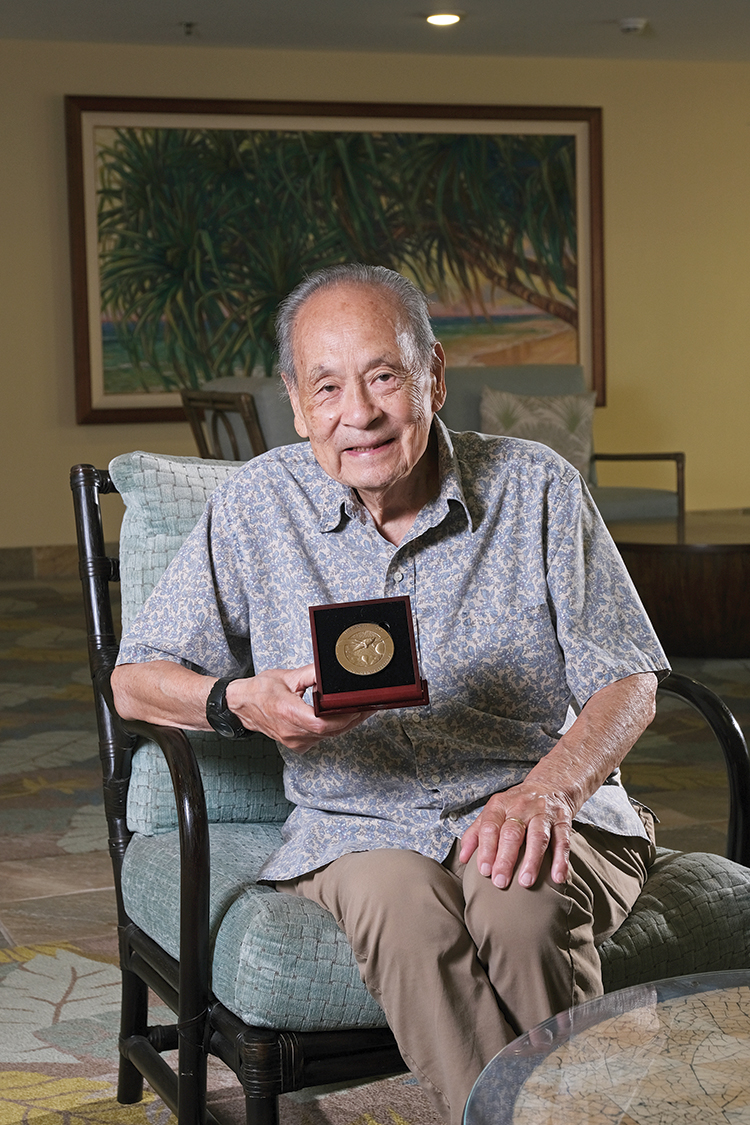
Photo by Lawrence Tabudlo
The way to a stronger and lighter future is through Stephen Tsai, a composite materials expert and the winner of the distinguished 2025 Daniel Guggenheim Medal.
People have long written or sung about different pathways to choose in life. Poet Robert Frost recommended taking the road less traveled, while Messrs. Plant and Page of Led Zeppelin fame emoted about “two paths you can go by, but in the long run, there’s still time to change the road you’re on.”
And then there’s New York Yankees great Yogi Berra, whose suggestion about what to do at any crossroads first caught the attention of Stephen Tsai many years ago.
“Yogi said, ‘When you come to a fork in the road, take it,’” recalls Tsai.
So, Tsai did just that — over and over again at every juncture in life, he’s refused to hesitate and simply moved forward.
Thank the stars for that decision because one of his earliest route choices led to groundbreaking achievements in the realm of composites — the field in which different materials are combined to create new ones like carbon fiber, fiberglass, plywood and reinforced concrete. Now six decades into his composites journey, Tsai is still in the enviable position of helping to shape the future of automobiles, spacecraft, airplanes and more by making their parts not only stronger than steel, but lighter than plastic, too.
For his valuable contributions in composites and especially as they relate to aeronautics, Tsai was recently honored with two prestigious awards: the 2025 Daniel Guggenheim Medal for his series of pioneering innovations that have revolutionized design and simplified the manufacturing processes of composites; and the 2025 Spirit of St. Louis Medal, which is awarded for meritorious service in the advancement of aeronautics and astronautics.
Both awards were established in 1929 — the same year that Tsai was born. By claiming these honors, the nonagenarian (he just turned 96 on July 6) joins the rarefied air of history’s aerospace icons. They include Holt Ashley, William Boeing, James Doolittle, Donald Douglas Sr., Igor Sikorsky and, of course, the Guggenheim Medal’s first-ever recipient, Orville Wright.
“If you look at the past winners, there are some really smart people … pioneers in aviation,” says Tsai, who’s been hailed as “a visionary scientist and advocate for innovation” by his admirers and who, when discussing composites, possesses the unique ability to make the profound plain and the prosaic palpably powerful.
Pausing briefly, he then adds with a smile, “When I accepted (the awards), I told everyone that I may not be the smartest (among past winners), but I’m sure I’m the oldest!”
While Tsai jokes about his place among the air travel immortals, the truth is that his spot in the cosmos is well deserved. Even he admits, “I’ve done things that, in their (the awards’ nominators) own words, have revolutionized how composites are being used — and that’s really in everything.
“But the aviation part is the most important.”
In the world of aviation, there are only two planes — the Boeing 787 Dreamliner and the Airbus A350 — that have airframes primarily made of composite materials. But that number could increase in the days ahead if Tsai and others of his ilk have their way.
Along with his team at Stanford University — where he taught until his retirement in 2001 — Tsai has created and argued for the use of a new family of laminates, one that he claims would bring “a renaissance to the composites industry,” producing not only better airplanes and cars, but lighter and stronger computers, cell phones and a manifold of other gadgets as well. Called double-double, this carbon epoxy laminate would replace the Quad laminate that has been in use since the 1960s.
“I think that almost anything that moves — cars, trucks, buses or any machine parts — will (eventually have to) switch to composites,” predicts the man who was elected to the National Academy of Engineering in 1995 and currently serves as an emeritus professor at Stanford’s Department of Aeronautics and Astronautics.
“It (the double-double) is lighter, it doesn’t corrode and it won’t fatigue.”
Among his achievements, Tsai is also responsible for the stress-based theory known as the Tsai-Wu failure criterion, a staple within the composites industry. This theory — which can accurately predict when composite materials will fail under different loading conditions — is used, for example, in the automotive world to design and analyze composite components like car body panels and chassis parts.
“Anybody that studies composites knows and uses this criterion,” he says.
Tsai began his work in composites at Aeronutronic, a defense-related division of Ford Aerospace located in Newport Beach, California, in 1961. At the time, he had no idea what composite materials were, but he soon learned. Over the next decade, his mastery of the subject would continue at Washington University and Air Force Materials Laboratory, where he served as chief scientist and later as its director of mechanics of composites. Along the way, he conducted composites computation workshops at University of California, Berkeley, training thousands of engineers. Ultimately, he landed a teaching gig at Stanford University in 1990.
Of course, Tsai almost didn’t go the composites route. Prior to joining Aeronutronic, he took a job with the New York-based engineering and construction company Foster Wheeler Ltd., and was paid an annual salary of $7,000. Encouraged by others to demand more, he asked for a $3,000 raise — and was promptly turned down.
“They could have paid me, but then my life would have been totally different,” he says.
So, Tsai took the fork in that road.
“There was absolutely no question that I made the right choice,” he adds.
Perhaps surprisingly, Tsai isn’t even the most recognizable member of his family today.
His youngest son, Ming-Hao Tsai, is a celebrity chef and restaurateur best known for challenging and defeating fellow celebrity chef Bobby Flay in season one of Iron Chef America (2005), and for his subsequent appearances on The Next Iron Chef (2010) and Top Chef (2014). Ming-Hao also operated Zagat-recognized establishments like Blue Ginger and Blue Dragon in Massachusetts until their closures in 2017 and 2020, respectively. Today, he runs the stylishly designed and Asian cuisine-inspired BāBā restaurant in Big Sky, Montana.
Additionally, granddaughter Lauren Tsai is a model and actress who was cast in the Netflix series Terrace House: Aloha State nearly a decade ago and who most superhero fans might remember as the Marvel Comics’ mutant Jia-Yi/Switch from the FX series Legion. And another granddaughter, Lauren’s older sister, Michelle Tsai, is a math tutor, adjunct lecturer and arguably the most prominent family member at the moment given her recent appearance on the game show Jeopardy!
But whether they’re renowned or not, Tsai simply delights in all of his progeny. They include a physical therapist, an active-duty U.S. Marine and an aspiring actor.
“They’re all very healthy and they’re all happy,” says Tsai, beaming with pride, “and that’s a lot to ask for because they don’t always come that way.”
When he was 19, Tsai left Beijing, China, to attend Yale University on a scholarship. At the time, he was simply following in his father’s footsteps, but that Ivy League pathway has since become sort of a family tradition. His sons and younger brother matriculated at Yale decades ago, and two grandchildren have also attended the private university in New Haven, Connecticut.
Like their father, both sons, Ming-Hao and older brother Ming-Hsi, chose to get degrees in mechanical engineering.
“I guess they figured I could always help them with their homework,” says Tsai in jest.
During his trips between China and America as a young adult, Tsai would have to make brief stops in Hawai‘i, then a territory of the United States. He specifically recalls visiting the islands shortly after he and his wife, Iris, wed in 1954, and being impressed by the greetings they’d receive from locals on layovers.
“The people here were so nice. They would go to the airport, which would only have a fence between us and the plane, and they would greet (the passengers) with lei. Of course, those things don’t happen anymore. Air travel is so different,” Tsai muses.
Still, the early demonstrations of aloha left a favorable impression on him and Iris and set the stage for their eventual move from Palo Alto, California to Honolulu. The relocation became permanent after Iris developed aspiration pneumonia while visiting a few years ago, and the couple ultimately settled at nursing home Kāhala Nui during the early part of the pandemic. Iris has since passed away, but Tsai continues to live at the retirement home, where he’s discovered the ideal spot to conduct the business of promoting his double-double laminate.
“I still spend about 10 hours a day working … I’m on my computer all the time,” he says.
“Honolulu is a very good place for me to work with people on the mainland, in the Far East and in Europe,” he adds. “From this one central location, I can do 24 hours of business with the three locations I work with. It’s something I can’t do if I’m still living in California.”
Fittingly, he credits much of his decision to call the 50th State home to good ‘ole Yogi Berra.
“You never know in life what will happen. Fortunately for us, we were already in Hawai‘i when COVID-19 happened and we wound up getting better care here than we would have in Palo Alto,” he says.
“But, as I like to say, when you come to that fork, just take it — don’t worry about it. It’s something I’ve done all my life.”