

Hurray for He‘eia
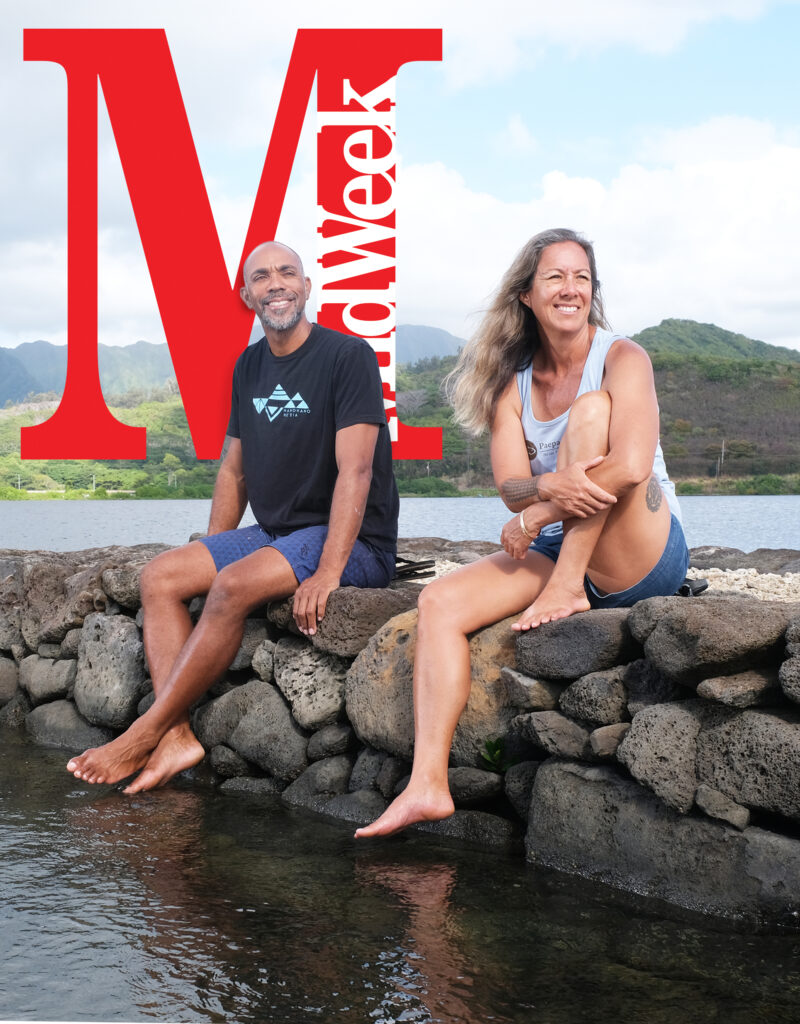
Photo by Lawrence Tabudlo
It’s taken a quarter of a century, but He‘eia Fishpond will soon be free of mangrove, thanks to the restoration efforts of Paepae o He‘eia and its leaders, Hi‘ilei Kawelo and Keli‘i Kotubetey.
It wasn’t long ago that Heʻeia’s most recognizable coastal landmark — its circular fishpond that was built sometime in the 12th century — had been lost to the general public, hidden behind and under a dense forest of mangrove trees.
Longtime Windward Oʻahu resident Hiʻilei Kawelo remembers those days.
“I grew up in Kailua, but my ʻohana is from Kahaluʻu,” Kawelo says. “I spent my whole life going back and forth on Kamehameha Highway, attending family parties at Heʻeia State Park and crossing the bridge.
“And I never knew the fishpond existed.”
But that began to change in the late ’90s. The ancient loko iʻa that was once lost to the masses had suddenly been found.
Since then, most of the invasive mangrove that previously blanketed the site and threatened to choke the life out of it has been cleared away, revealing a magnificent and massive 1.3-mile wall, or kuapā. One of the structure’s most impressive features is its seven sluice gates, or mākāhā, which allow both fresh and salt water to enter the 88-acre site and maintain its brackish-water environment. The briny conditions are perfect for hosting a variety of aquatic life, including fish (ʻama ʻama, palani, āholehole, pāpio, etc.), crab, shrimp and eels.
Yet despite the fishpond’s optimal setting, a portion of mangrove — which was introduced to Heʻeia more than a century ago and which gained an even stronger foothold following heavy flooding in May 1965 — still remains.
Fortunately, the days of the mangrove are just about numbered.
A community workday called Moʻokuapā is taking place later this year (Dec. 13) when a hopeful army of volunteers will gather to remove the remaining 300 feet of thicket along the fishpond’s mauka wall.
Kawelo — who serves as executive director of Paepae o Heʻeia, a nonprofit dedicated to the restoration and maintenance of the fishpond — is aiming for a sizable turnout of volunteers. She’s also looking forward to finally saying good riddance to the once ubiquitous and annoying tropical plant.
“We’re hoping to get 2,000 (volunteers),” she says. “Dec. 13 will mark the end of the restoration … an opportunity to put the finishing touches on this last section of mangrove.”
To fund Moʻokuapā, the community benefit Nā Moʻolelo Hawaiʻi will be staged from 10 a.m. to 3 p.m. Oct. 18 at Windward Mall. There, attendees will be treated to a family mask-decorating activity, a high school visual storytelling competition, and readings by well-known storytellers Lopaka Kapanui and Moses Goods, an actor who stars in the brand-new Apple TV+ series Chief of War.
“Nā Moʻolelo Hawaiʻi is a kāhea (call out) for everyone,” says event planner Billie Gabriel. “It’s family-oriented, it’s imaginative and it’s interactive. It supports storytelling through culture and arts.”
During the benefit, tales of the fishpond wall will be shared to honor those who have contributed “to 800 years of existence and the last 25 years of restoration,” says Kawelo.
The occasion, she adds, will be “a pule (prayer) of continuum.”
Those interested in mask decorations may purchase $15 kits starting on Sept. 15. The materials will be distributed on the day of the event.
Meanwhile, the storytelling competition (10 a.m.-1 p.m.) will feature student and kūpuna teams creating moʻolelo (stories, myths, legends) about Oʻahu’s spine-tingling encounters with torch-bearing Night Marchers.
Finally, Kapanui and Goods’ storytelling sessions (10:30 a.m.-noon) will be staged at Regal Theaters. Seating is limited and general admission tickets may be bought beginning Sept. 15.
Aside from funding the community workday in December, monies raised will also go toward the purchase of moss rock and coral to complete the restoration of the fishpond wall — all in an effort to, according to Gabriel, “help Paepae o Heʻeia continue the moʻolelo of our kūpuna who first built this Heʻeia fishpond for our makaʻāinana (people of the land).”
Kawelo first became aware of the fishpond while a student at the University of Hawaiʻi in the late ’90s. At the time, she “had all this energy and wanted to fix everything,” and so she decided to jump into a class project at the loko iʻa.
“We cleared a section of the wall and freed it of mangrove, which was all around the perimeter with the highest concentration by the bridge,” Kawelo recalls. “We could only walk single file along the wall and duck under branches because it was just a tunnel of mangrove.”
Her interest in the fishpond’s well-being eventually led to the formation of Paepae o Heʻeia in 2001. Kawelo is one of seven co-founders of the nonprofit and has guided the group since 2007, when she stepped in for departing executive director and co-founder Mahina Paishon-Duarte.
“Mahina was actually the first to start volunteering out here at the fishpond,” Kawelo says. “She’s still around and we still partner up on a ton of things. In fact, she still gives me pointers.”
While Kawelo admits to feeling a sense of accomplishment with the transformation of the fishpond, she also notes that the primary mission of Paepae o Heʻeia has always been geared toward teaching others.
“It’s about educating our people and our students, and engaging learners. The restoration part was always second,” she explains. “But somewhere along the way the two goals became complementary, and it makes all the sense in the world to have students involved in the restoration process so that there’s skin in the game.”
The organization accomplishes its educational pursuits through partnerships with several primary and secondary schools. (Even college students from here and abroad have been active learners and participants at the fishpond.) Currently, Paepae o Heʻeia collaborates with Hālau Kū Māna and Mālama Honua public charter schools, as well as Mid-Pacific Institute and King Intermediate School. This year, eighth-graders from Kamehameha Schools will also become part of the partnership program.
“I think they’ll be coming out eight times during the calendar year. It’s a great thing, and we’re so excited about it,” Kawelo says.
Looking ahead, Kawelo envisions the fishpond ultimately turning into a site for sustainable fish harvesting.
“I’d love to see that, especially now that the restoration is almost done,” she says.
Yet even with the mangrove nearly vanquished and the majority of the wall restored, there are new threats on the horizon — namely, upside-down jellyfish (Cassiopea) and invasive seaweed like Lyngbya and Gorilla Ogo.
According to Kawelo, Heʻeia Fishpond can’t be fully healthy until the jellyfish and seaweed are removed.
“But it’s tough to get rid of them,” she adds.
At the moment, the nonprofit is searching for solutions. Fellow Paepae co-founder Keliʻi Kotubetey, who serves as the nonprofit’s assistant executive director, believes a multi-pronged attack will be needed to succeed against the invading jellyfish.
“Putting something into the pond that’s native and will eat jellies — like turtles — would be wonderful,” Kotubetey says. “Of course, they’re endangered, so you’re not supposed to touch them or handle them. But if we could figure out a (legal) way to get turtles into the pond, that might be able to help us.”
In the meantime, Kawelo and the rest of Paepae o Heʻeia will — like the life-sustaining water passing through the mākāhā — keep flowing forward.
“You can’t be stagnant,” she says. “We’re too busy restoring our community and restoring our cultural practice.”
But she’s also patient. Twenty-five years of battling mangrove has taught her how to pace herself and play the long game well. Come December, her endurance will be well-rewarded when the last branches of the invasive tree are finally hauled away.
“Slow and steady,” Kawelo says.“That’s what has allowed us kanaka to exist and persist all these many hundreds of years.”