

How to train A.I.
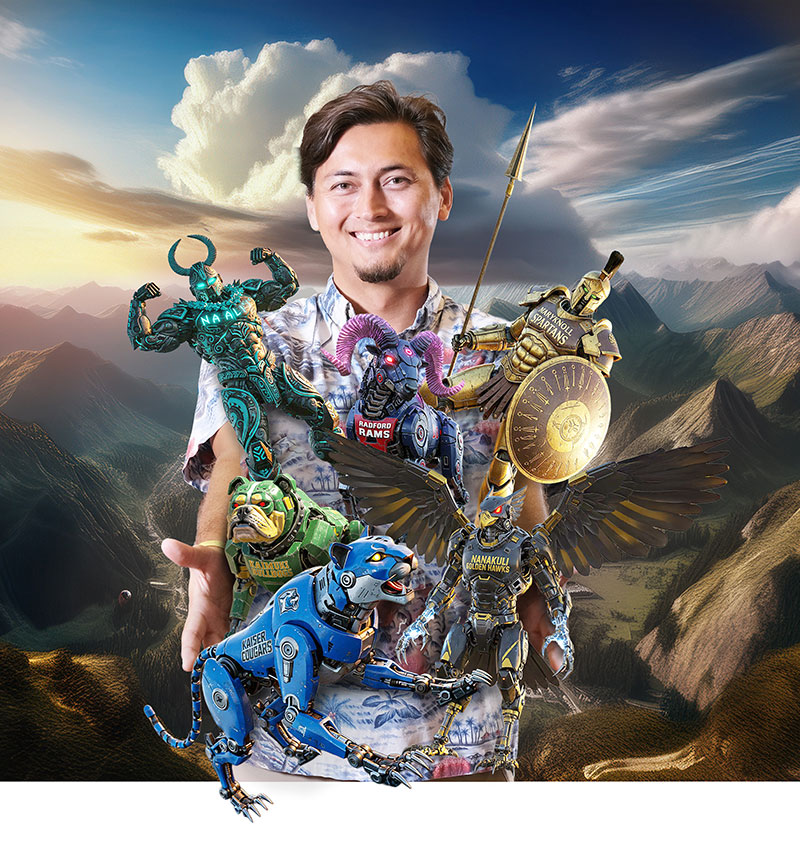
Yanagihara used Google’s text-to image A.I. program Imagen 3 and Google’s text-to-video A.I. programs VEO 2 and VEO 3 to create the original high school mascots shown here. Images courtesy Gabriel Yanagihara
Gabriel Yanagihara identifies as a golden retriever. Not literally, but he likes to project the friendly enthusiasm of the breed consistently ranked among the nation’s most popular by the American Kennel Club.
Also, he probably could turn himself into a human-golden-retriever hybrid if he wanted to. The Maui-born 35-year-old and local A.I. evangelist has already used artificial intelligence to re-imagine more than a dozen Hawai‘i high school mascots.
His viral videos of humpback whales in the Ala Wai Canal and snow in Waikīkī garnered millions of views on social media. Those clips — created with Google’s text-to-video A.I. program Veo 2 — highlight the power of this emerging technology as well as the confusion and misinformation that swirls in its wake. Even though Yanagihara labeled the pieces “A.I. generated,” many viewers mistook them for reality.
That’s a little alarming — but it also presents a learning opportunity. You see, Yanagihara wants everyone in Hawai‘i to become A.I. literate. In addition to being an artist whose A.I. work has gone viral, he’s also a computer science instructor at ‘Iolani School’s Sullivan Center for Innovation and Leadership, and he just received a master’s degree in education from University of Hawai‘i at Mānoa. Teaching is his wheelhouse.
At his A.I. workshops — which he makes clear are not necessarily affiliated with ‘Iolani — he aims to provide a working understanding of how A.I. operates under the hood, a hands-on experience with free and paid versions of A.I., and a framework for evaluating the ethical and cultural implications of using A.I. He also offers long-term support, such as regular coaching sessions. He says many clients want help building train-the-trainer programs to get the most out of their A.I.
“My journey has been adapting to whatever the crazy new tech has been,” he says. “So at all my keynote speeches and workshops, I’ve been like a little guinea pig. I try new things and see what works.”
In other words, don’t be scared, be curious.
Depending who you ask, the latest iterations of generative A.I. — large language models like Anthropic’s Claude, OpenAI’s ChatGPT and Google’s Gemini, and text-to-art programs like Midjourney, DALL-E 3 and Stable Diffusion — are either going to open the door to a world of unimagined creativity or render humankind obsolete.
Yanagihara tends to walk the middle road — A.I. probably won’t save the world or end the world, but it will change the world.
“My first serious interaction (with A.I.) was with ChatGPT in late 2022,” he recalls. “I realized immediately that it would change how I teach, write and think. Within minutes, I had completed a whole semester of work and prep.”
ChatGPT can mimic the tone and complexity of human conversation, while also completing in minutes — or even seconds — tasks and research that would take an ordinary person hours, weeks or maybe even years.
“I knew it would open a whole new world for educators and if we didn’t get this right, Hawai‘i would be left behind,” Yanagihara continues. “I saw the wave on the horizon and right now I’m telling everyone we have to be paddling now if we hope to catch and ride it.”
MidWeek downloaded a free version of ChatGPT a couple of days before the interview with Yanagihara, and asked it to summarize the transcript of the hour-and-a-half interview. In the blink of an eye, it produced a well-organized list divided into neat sections highlighting his approach to teaching and innovation, his philosophy on A.I. in education and his thoughts on the importance of communicating with diverse audiences, to name just a few.
MW then asked ChatGPT if we had gotten any good quotes. In another blink of the eye, we received the following:
“It cuts down the work I have to do by like 80%, 90% — and the outcomes are way better.”
“Now I have probably twice as much work time and content in the class than I used to because I can automate the process.”
“You can choose to use the tools in a good way or a bad way. The hard part is getting them to choose the good use.”
“What if every student had an A.I. tutor that could answer questions at 11 at night? Not do the work for them, but meet them where they are?”
MW then prompted it to search for discrepancies, inaccuracies or missing pieces. It flagged his comment that the United Arab Emirates had bought ChatGPT for every citizen. It clarified that the UAE had invested heavily in A.I. (like Mohamed bin Zayed University of A.I.) but there was no confirmation that the nation had purchased ChatGPT for its citizens.
MW’s version of ChatGPT also clocked his speaking style as “big picture” and “entrepreneurial,” and posited that he was speaking off the cuff instead of reading off a pre-written script.
The interview was conducted over Zoom and Yanagihara did not appear to be reciting a script. In fact, Yanagihara (who also co-owns Cafe Villamor in Kaka‘ako) had referred to himself as entrepreneurial and had been making a larger point about how other nations were already pushing A.I. heavily, leaving the U.S. — and Hawai‘i — in danger of falling behind.
Incidentally, ChatGPT also offered to write this article, but that was a bridge too far for MW’s flesh-and-blood editors.
Cheating has been a major concern since ChatGPT debuted in November 2022. After all, if a chatbot can write an essay or article just as well as a human (or even better than a human, some argue), why would a human bother writing?
Yanagihara has heard this argument before, and says he prefers to focus on results. Did A.I. help you reach more people with your marketing message? Did it help you launch an initiative to clean up the Ala Wai? Did it help grow a community gathering into a grassroots movement? Did it help you publish your book?
And he emphasizes that the human is still in the driver’s seat.
“A.I. is just math. It’s statistics,” he says. “It doesn’t know anything. It doesn’t care about you. It’s not a person … You’re the one that drove the change.”
He also believes that as “A.I. slop” — generic and often misleading content produced by A.I. — becomes more pervasive, those who can leverage A.I. to enhance, not replace, their voice and creativity will likely come out on top.
“More than ever, the taste and expertise and quality control that you have over what goes out is going to be really important,” he says. “There’s going to be a big push toward authenticity. Anyone new coming to market now, everyone is going to be like, ‘Are you good or did you just use A.I. tools?’ You’re still the curator and the brand and the type of stories you want to run and the perspective that you give … I think (that) is going to be the differentiator in the coming years.”
In classrooms, he says, this might translate to more project-based learning, possibly guided by A.I. tutors, with teachers serving as mentors and facilitators.
In his own classes, he says, he’s already doing “a lot less ‘look at your screen and copy what I say’ and more ‘here’s your A.I., build something cool and show me.’”
If pushed, though, the golden retriever says he understands why folks might find all of this unsettling. He’ll even admit it can be a little unsettling to him, too.
Despite his earlier observation about A.I. not being human, anyone who’s used ChatGPT will notice how human-like it is and how unrelenting it is in offering to complete tasks for you.
Perhaps it’s not surprising Yanagihara found that kids seem to approach A.I. with openness and curiosity, while adults tend to be wary or even cynical.
Then again, some wariness may be warranted, considering how much information is shared with A.I. and the fact that there’s no comprehensive regulation of this technology in the U.S. Where is that information going and how could it be used in the future?
On the other hand, Yanagihara says A.I. is already here, in classrooms throughout the state and more and more in all of our lives — so those who don’t join the conversation won’t be part of shaping the future.
Whether you’re an enthusiastic child, a wary adult or someone not even that interested in using A.I., he says we could all benefit from learning about a technology that will impact us in one way or another.
A.I. ROUNDTABLE
‘Iolani School is hosting a free A.I. In Education Roundtable from 5:30 to 6:30 p.m. Sept. 10 at the school’s Sullivan Center for Innovation and Leadership. It’s part of Honolulu Tech Week 2025. The panel will feature teachers, students and representatives from the tech industry. Sign up at lu.ma/th7gi2r8.
To keep up with Yanagihara, visit gabrielyanagihara.substack.com.